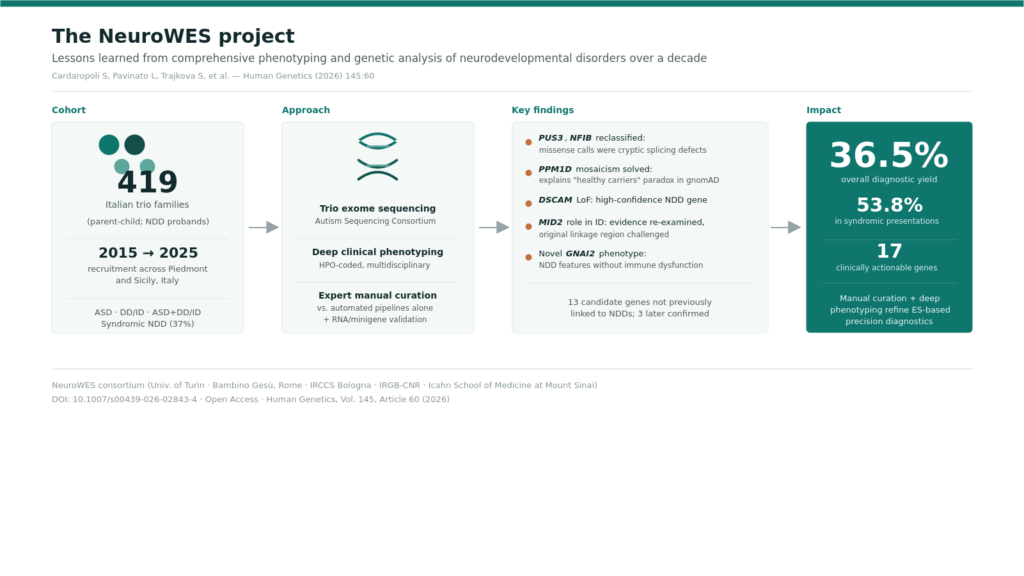
A new international collaborative study involving the NeuroWES Consortium, with the contribution of the research team led by Andrea Angius at the CNR-Istituto di Ricerca Genetica e Biomedica (IRGB), has provided important insights into the genetic basis of neurodevelopmental disorders through the analysis of one of the largest Italian cohorts investigated by exome sequencing over the last decade. The findings, published in Human Genetics in the article “The NeuroWES project: lessons learned from comprehensive phenotyping and genetic analysis of neurodevelopmental disorders over a decade”, demonstrate how the integration of genomic technologies and deep clinical phenotyping can substantially improve the diagnosis and understanding of rare neurodevelopmental conditions.
The study summarizes more than ten years of multidisciplinary research combining advanced genomic approaches with detailed clinical characterization. By analyzing 419 patient-parent trios affected by neurodevelopmental disorders, researchers showed that the combination of exome sequencing and deep phenotyping improves diagnostic accuracy, uncovers novel disease mechanisms, and refines the interpretation of rare genetic variants.
Beyond its diagnostic value, the project offers an important model for the interpretation of complex genomic data, highlighting how close collaboration among clinicians, geneticists, and bioinformaticians can accelerate discoveries in rare disease research and precision medicine. Following publication, the study attracted significant attention within the international genetics community through dissemination across major biomedical databases, scientific networks, and specialized research platforms, reflecting both the scientific relevance of the findings and the growing impact of collaborative genomic initiatives in neurodevelopmental disorders.
The participation of the CNR-IRGB further strengthens the institute’s role in international efforts aimed at improving the diagnosis, understanding, and clinical management of rare neurodevelopmental disorders through genomic medicine.
The research was supported by multiple individual grants including: European Union-NextGeneration EU PNRR-MR1-2022-12376067 “Multiomic strategies to implement the diagnostic workflow of rare diseases”; from the Italian Ministry of Health (PNRR-MR1-2022-12376811 and RF-2021-12374963, to MT), from the Italian Ministry for Education, University and Research (MIUR) PRIN2020 code 20203P8C3X. Associazione Emma ed Ernesto Rulfo per la Genetica Medica, Enrico e Ilaria sono con noi ONLUS, Fondazione Ospedale Infantile Regina Margherita, Beatrice A. Seaver Foundation.
LINK to original article: https://link.springer.com/article/10.1007/s00439-026-02843-4#Fun